tattoo ideas
A lot of people know they want tattoos, but they don’t know what to get.
I met a guy the other week who said he had always imagined himself with a full sleeve, but he didn’t know what to get.
I asked his girlfriend, When you see tattoos on a man and they look hot, what do they look like?
She said, Tattoos are hot when they look like something I haven’t seen before or they’re done in a unique style. It makes me want to ask what it is and who did it.
A tattooer I respect once said that the desire to get a tattoo always comes first. Then we find the image, the artist, and the story that we tell ourselves about why we are getting tattooed.
When I started tattooing it was important to me that every tattoo had a reason and a story. I was doing a lot of illustration tattoos. Then I started noticing a shift in the opposite direction. More people were getting tattoos that were intentionally funny or didn’t have a story connected to them. People were tired of trying to have the most meaningful story to tell about their tattoos—it’s exhausting. The less serious the better. I met someone who had a tattoo of Teletubbies jumping out of a burning tower and she said her artist drew it in an Uber on the way to her appointment.
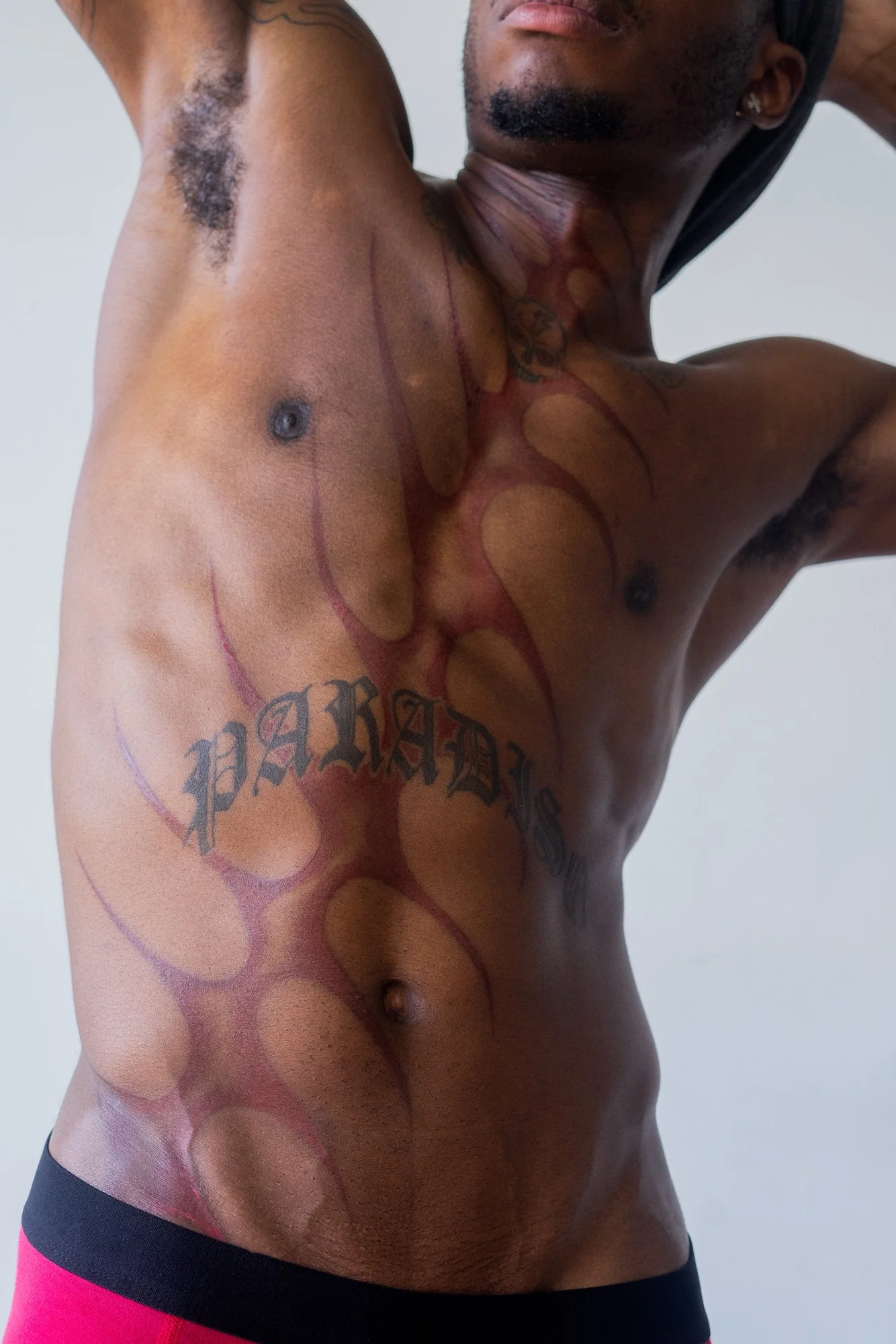
Tattoo compositions are changing too. When I first started noticing tattoos, a lot of people would fill up one arm at a time and isolate tattoos to specific body parts.
A few years ago I approached an artist to design a thigh piece for me. I had a tattoo on my opposite thigh, and I wanted the designs to mirror each other. The artist said, Why not extend the tattoo onto your lower leg and stomach too? I thought about it for a while and realized that I was so attached to the idea of symmetry. Why is it so common for tattoos to be symmetrical when there are so many other compositions that are possible?
During one of our sessions, I watched my artist enter a flow state and fill in a large area of the tattoo without transferring a drawing in advance. This is known as freehand tattooing. I was terrified that he was going to mess up my tattoo doing this abstract filler thing in the middle of a big illustrative piece. Later, looking in the mirror at home, I realized that what Miles Davis said is true: Do not fear mistakes. There are none. The artist finished my tattoo in 40 hours, and his piece won an award at a convention.
My experience of getting this tattoo made me realize that what interested me the most about tattooing was activating the body. With illustrative tattoos, I would work myself into a corner by drawing something specific and isolating the design to a small part of the body.
A year or so later, I found myself in the dead of winter, and I was unhappy with my tattooing practice. I kept taking any project that came my way, even if i wasn’t passionate about it. I was getting burnt out. I walked in the dark and the snow to an art supply store and bought a 3ft-wide roll of glassine. A friend came to visit and talked to me about doing a little angel neck piece. I said, Let’s try something. I rolled out the glassine and asked him to lay down on it. I traced out his silhouette and the next day I painted an abstract form on the roll of glassine that cut down through the center of his body.